
Subperiosteal implants are attracting renewed interest in modern dental implantology, particularly for patients with severe jawbone atrophy. Advances in digital imaging, computer-aided design and 3D printing have transformed an established technique into a more precise and personalized treatment option.
However, these technological developments also introduce new clinical challenges. Successful treatment requires more than conventional implantology skills. From patient selection to prosthetic rehabilitation, every stage demands specific knowledge and careful planning.
This is why advanced training in subperiosteal implants is becoming increasingly important for dental professionals seeking to expand their expertise in complex implant rehabilitation.
The Evolution of Subperiosteal Implants in Modern Dentistry
Subperiosteal implants were originally developed to rehabilitate patients with insufficient bone volume for conventional dental implants. Unlike endosseous implants, which are inserted into the jawbone, subperiosteal implants consist of a customized framework positioned on the bone surface, beneath the periosteum.
Historically, their clinical use was limited by manufacturing constraints, difficulties achieving an accurate fit and the risk of complications.
Today, digital technologies have significantly changed their design and manufacturing processes. Cone beam computed tomography (CBCT), computer-aided design and additive manufacturing make it possible to create patient-specific titanium frameworks adapted to individual anatomy.
These developments have renewed interest in subperiosteal implants as an alternative for selected patients who might otherwise require complex bone augmentation procedures.
Nevertheless, technological precision does not eliminate surgical risks. Appropriate expertise remains essential, particularly when treating severely resorbed jaws.
Why Patient Selection Requires Specialized Knowledge ?
One of the most important aspects of subperiosteal implant treatment is determining whether a patient is a suitable candidate.
Severe bone loss does not automatically justify choosing this technique. Clinicians must consider several factors, including:
- The degree and distribution of jawbone atrophy.
- The quality of the remaining bone and soft tissues.
- The patient’s general health and medical history.
- Available alternatives, including bone grafting and conventional implant solutions.
- Prosthetic requirements and anticipated functional loads.
Advanced training helps practitioners evaluate these parameters and establish appropriate indications and contraindications.
It also encourages a comprehensive treatment approach, ensuring that clinical decisions are based on individual patient needs rather than the availability of a particular technology.
Mastering Digital Planning and Customized Implant Design
Digital planning plays a central role in contemporary subperiosteal implantology.
The process generally begins with CBCT imaging, which provides detailed three-dimensional information about the patient’s bone anatomy. This information supports the design of a customized implant framework and the planning of its surgical positioning.
However, interpreting imaging data and validating implant designs require specific competencies.
Clinicians must understand how anatomical structures influence implant design, where fixation points can be safely positioned and how prosthetic requirements affect the final framework.
Effective communication with designers, laboratories and other members of the treatment team is equally important.
Specialized courses can help practitioners develop these skills while understanding the limitations of digital planning tools. The objective is not simply to operate software but to make informed clinical decisions throughout the design process.
From Theoretical Knowledge to Practical Surgical Skills
Although digital planning provides a detailed surgical roadmap, translating that plan into clinical practice requires considerable expertise.
Subperiosteal implant placement involves surgical exposure of the jawbone, accurate positioning of the customized framework, fixation and careful management of surrounding soft tissues.
Each stage presents potential challenges, particularly in patients with advanced bone resorption.
For clinicians looking to develop these competencies, structured training programs combining theoretical education, digital planning and practical surgical exercises are available, as presented on www.subperiosteal.com.
Hands-on workshops are particularly valuable because they allow practitioners to become familiar with surgical instruments, anatomical considerations, implant positioning and prosthetic procedures.
Simulation also creates opportunities to identify technical difficulties and discuss appropriate responses before encountering similar situations in clinical practice.
Such experience complements existing surgical expertise and supports a more systematic approach to complex treatments.
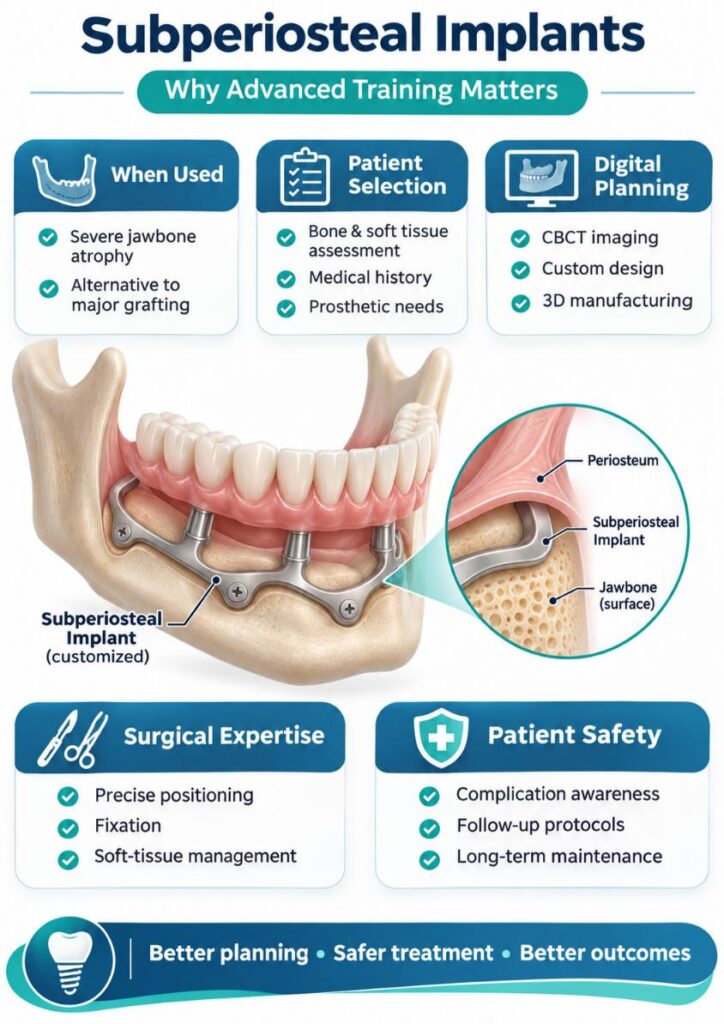
Subperiosteal implants offer promising possibilities
Understanding Complications and Improving Patient Safety
Subperiosteal implants offer promising possibilities, but they are not free from complications.
Clinical difficulties may include soft-tissue dehiscence, exposure of the implant framework, infection, fixation problems or prosthetic complications.
The risk and severity of these events depend on multiple factors, including patient characteristics, surgical technique, implant design and postoperative maintenance.
Advanced training therefore needs to address more than successful implant placement.
Practitioners should develop competencies in:
- Identifying anatomical and biological risk factors.
- Planning appropriate soft-tissue management.
- Recognizing early signs of complications.
- Evaluating treatment options when complications occur.
- Establishing individualized maintenance and follow-up protocols.
Recent clinical research reports encouraging short-term survival rates for modern customized subperiosteal implants. Nevertheless, long-term outcomes remain less well established, and soft-tissue complications continue to require particular attention.
A responsible clinical approach therefore combines technical expertise with realistic expectations and transparent patient communication.
The Importance of Prosthetic Planning and Multidisciplinary Collaboration
Subperiosteal implant treatment does not end when the framework has been surgically positioned.
The final objective is to achieve functional and maintainable prosthetic rehabilitation.
Prosthetic planning should consequently begin before implant manufacturing, with careful consideration of occlusion, available restorative space, implant positioning and future hygiene requirements.
Depending on the clinical situation, treatment may involve provisional restorations followed by definitive prosthetic rehabilitation.
Understanding the relationship between implant design and prosthetic function is essential for preventing avoidable mechanical problems.
Advanced education encourages closer collaboration between dental surgeons, prosthodontists and dental laboratory professionals, helping ensure that each stage contributes to the overall treatment strategy.
Why Continuing Education Remains Essential ?
Completing an initial training program represents an important step, but professional development should continue as techniques and scientific evidence evolve.
Research into biomaterials, implant surface characteristics, digital workflows and surgical protocols continues to influence contemporary subperiosteal implantology.
Dental professionals benefit from maintaining their knowledge through scientific publications, practical workshops, clinical case discussions and professional exchanges.
Continuing education also provides opportunities to examine complications, critically assess emerging techniques and distinguish promising innovations from procedures supported by stronger clinical evidence.
The ultimate objective is not simply to perform more complex procedures, but to make better-informed treatment decisions while maintaining high standards of patient care.
Frequently Asked Questions About Advanced Subperiosteal Implant Training
Who should consider specialized training in subperiosteal implants?
Training is primarily relevant to dental surgeons and appropriately qualified clinicians with existing implantology or oral surgery experience who want to deepen their understanding of severely atrophic jaw rehabilitation.
The necessary qualifications and scope of practice depend on local professional regulations.
Is digital planning knowledge sufficient to perform these procedures?
No. Digital planning is an essential component, but it cannot replace surgical expertise, anatomical knowledge or practical experience.
Clinicians must also understand implant fixation, soft-tissue management, prosthetic requirements and complication management.
What makes hands-on training particularly valuable?
Practical training helps clinicians connect theoretical knowledge with surgical procedures. It provides opportunities to rehearse technical steps, develop familiarity with instruments and discuss complex clinical situations under appropriate supervision.
It should complement, rather than replace, supervised clinical experience.
The renewed interest in subperiosteal implants reflects important advances in digital dentistry and personalized implant rehabilitation.
For selected patients with severe jawbone atrophy, these devices may offer an alternative to more extensive reconstructive procedures. However, their successful use requires a comprehensive understanding of diagnosis, digital design, surgical protocols, prosthetic rehabilitation and long-term maintenance.
Advanced training is therefore a fundamental part of developing the competencies required for responsible subperiosteal implant practice.
By combining scientific knowledge, practical experience and continuing professional education, clinicians can approach complex cases with greater confidence while keeping patient safety and individualized care at the center of their decisions.